
Why automated sorting
There are many reasons why companies decide to automate sorting processes. Sorting itself is the process of dividing goods into different destinations depending on their characteristics, use, or final shipping location. To make this division, a series of repetitive and often tedious actions must be carried out: inspecting each item, scanning its code, and then placing it—according to that code—into the correct location. With large volumes of goods, it is difficult to ensure the required efficiency and continuity of the sorting process. Manual workers are increasingly reluctant to take on this type of job, which is visible on the labor market. A manual sorting process is highly prone to human error resulting from the repetitiveness of the tasks performed. Incorrectly dispatching goods and having them reach the wrong recipient is very costly for a company, as it involves complaints and returns, as well as reshipping the items.
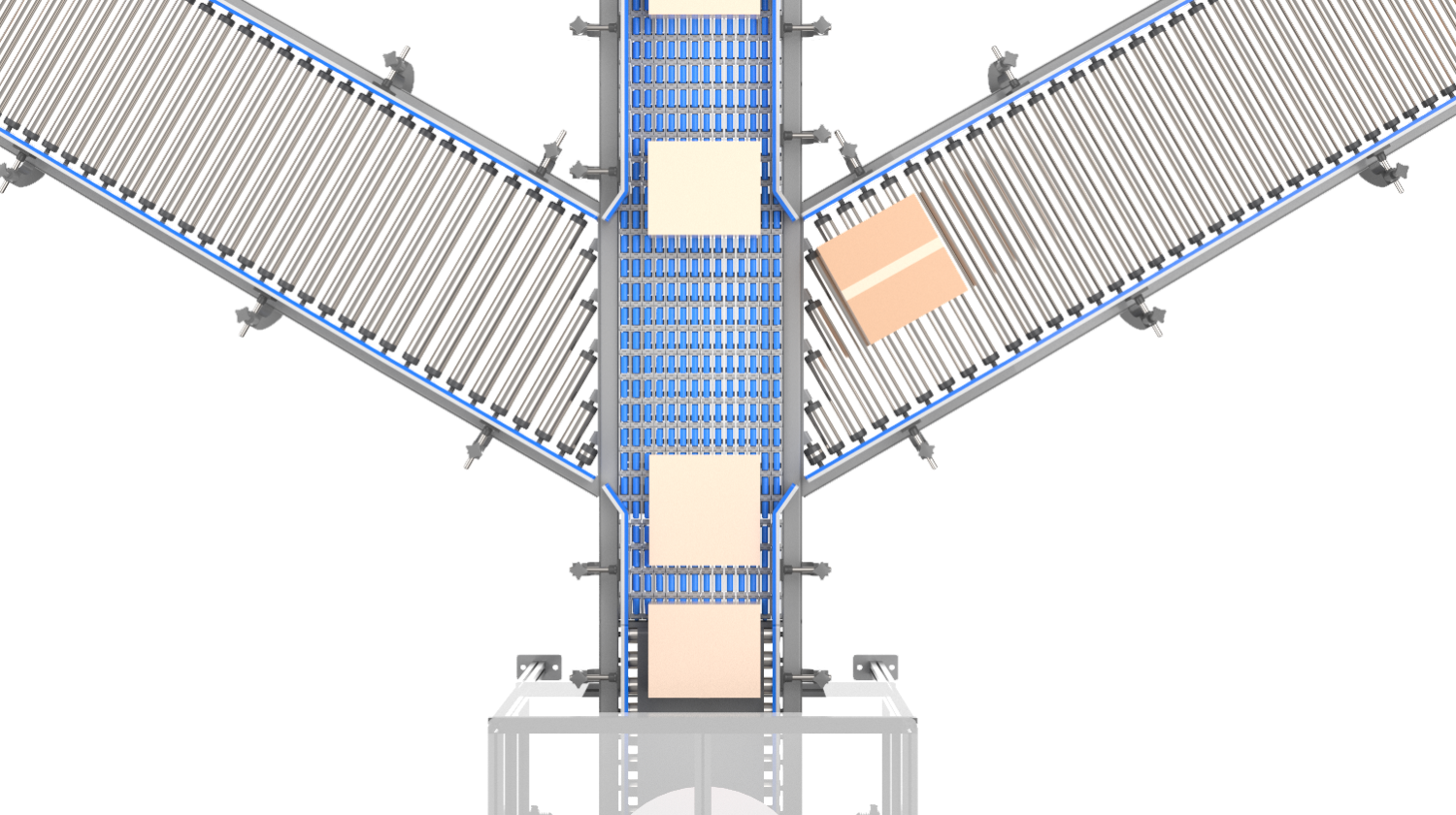

Higher efficiency and greater throughput
Smooth handling of large volumes of goods, reduction of bottlenecks when order quantities increase, while also increasing the number of parcels processed during a single shift.
Error reduction and improved customer service quality
Product identification is handled by a vision system, ensuring that each parcel is automatically directed to the correct destination. This helps avoid mistakes and mix-ups that often occur during manual sorting and, as a result, leads to more satisfied customers.

Lower operating costs
Fewer labor hours needed for the same order volume, fewer complaints caused by human errors, and better use of energy and resources thanks to a stable, consistent process.
Optimal use of warehouse space
Installing a sorter in the warehouse ensures efficient use of available space and integrates different warehouse zones into one logical whole. On the basis of the sorter, it is easy to plan the layout of feeding lines or shipping zones. The sorter itself can also be expanded when needed, for example by adding specific destinations.

Increased safety
Less heavy lifting and walking around the warehouse for operators. Instead of performing strenuous and injury-prone physical work, operators can focus on supervising the sorter and stepping in only when necessary to support the process.

Ability to modify the process and continuously optimize it
Automated sorting is a process that can be adapted to changing needs. The sorter can be adjusted to the type of operation. The sorting system records data such as cycle times, loads, errors, and downtime, which can then be used to optimize and improve the system.